Canadians are increasingly concerned about violence in public schools and want governments to act
The latest results from a national survey show that concern about violence and aggression in public schools remains widespread — and is rising.
Article originally published by Abacus Data.
For the last three years, Abacus Data have been tracking Canadian public opinion on public education on behalf of the Canadian Teachers’ Federation (CTF/FCE). The latest results, from a national survey conducted March 17 to 23, 2026, among 2,000 Canadian adults, show that concern about violence and aggression in public schools remains widespread — and is rising.
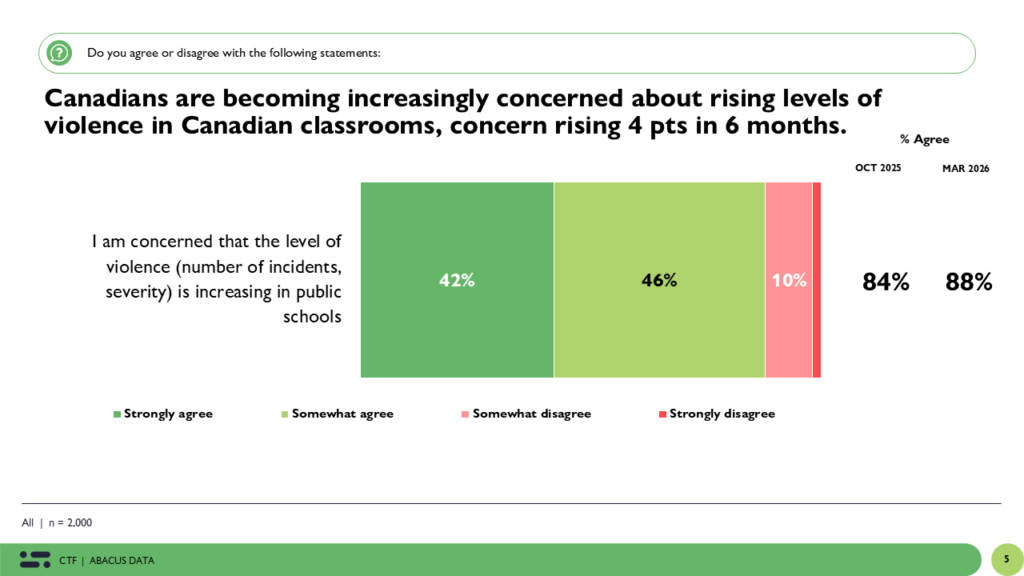
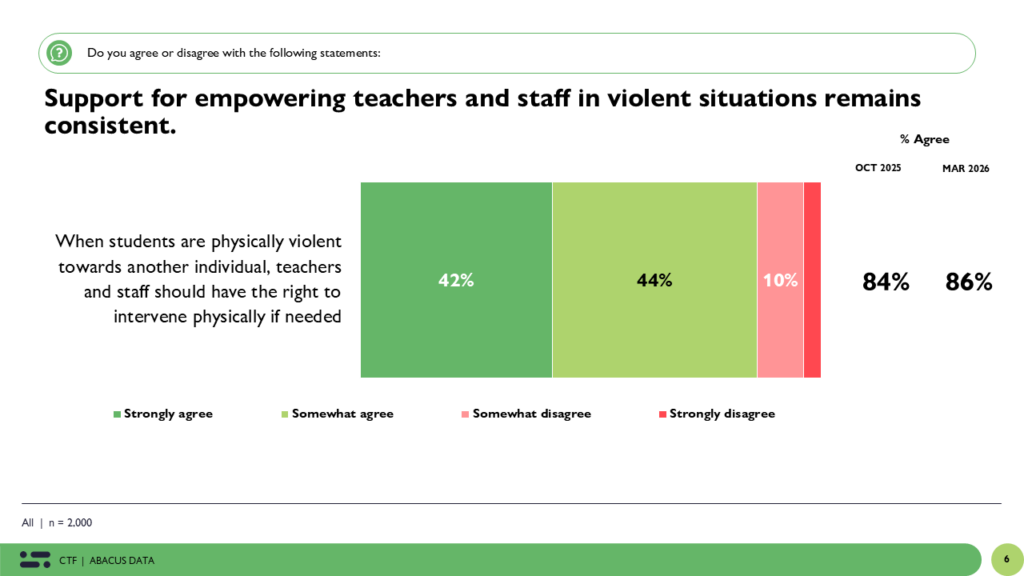
Today, almost 9 in 10 Canadians say they are concerned that the level of violence in public schools is increasing. That is up 4 points over the past six months, from 84% in October 2025 to 88% today. At the same time, 86% agree that when students are physically violent towards another individual, teachers and staff should have the right to intervene physically if needed.
Taken together, these findings point to a public that sees school violence as both a growing problem and an urgent one — not only for students, but for the adults responsible for keeping schools safe.
Concern about school violence is broad and growing
Canadians are not divided on whether violence in schools is becoming more serious. The public is broadly aligned: concern is high, and it has intensified since the fall.
This concern is especially pronounced in Quebec and among parents with children over the age of 18, suggesting that anxiety about what is happening in classrooms extends well beyond those currently parenting younger school-aged children.
There is also strong support for giving teachers and staff the authority to respond in situations involving physical violence. While this measure has changed little since October, the consistency of support is notable: Canadians appear to recognize that school staff need to be able to act in moments where safety is at risk.
Canadians see deeper causes behind growing aggression in schools
When asked what is driving growing violence and aggression in schools, Canadians are most likely to point to a lack of respect for the profession and for teachers. Nearly seven in ten rank this among the top contributors. Overcrowded classrooms follows closely behind, while many also identify gaps in mental health supports, educational assistants, and de-escalation training as important factors.
These findings suggest Canadians do not see rising violence as an isolated behavioural issue. Instead, they connect it to broader pressures in the school environment — pressures that affect classroom conditions, staff capacity, and the level of support available to students and educators.
This aligns with what educators themselves are reporting. In a recent survey of K-12 educators across Canada done by the CTF/FCE, 87% agreed that violence and aggression is increasing in public schools. That finding helps reinforce that the public’s concerns are not abstract: they reflect a challenge that educators are also experiencing directly. [Parachute Fall 2024]
Canadians want federal government action, even in an area led by provinces
Although K-12 education falls primarily under provincial and territorial jurisdiction, Canadians do not believe that should prevent action from other levels of government. More than three-quarters say the federal government should take action to address rising violence and aggression in K-12 schools.
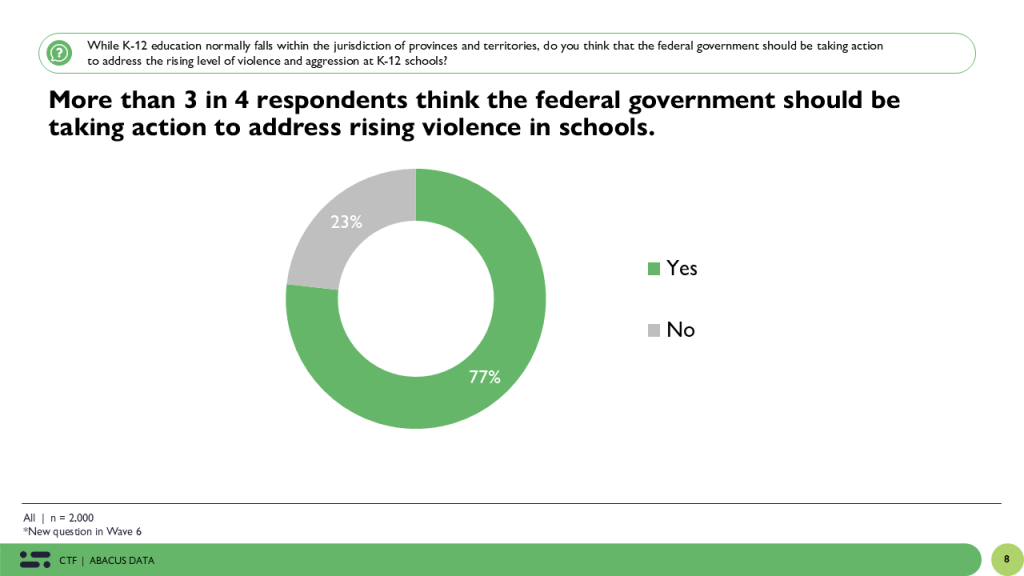
That is an important finding. It suggests the public is less concerned with jurisdictional boundaries than with whether governments are responding to a visible and growing problem in schools.
There is support for a range of policy responses
Support is strong for each of the policy options tested.
The most popular proposal is introducing and imposing maximum teacher-to-student ratios, supported by 72% of Canadians. There is also broad support for establishing minimum supports for students with special needs through a federally funded support program (73%), creating a major federal transfer to provinces and territories specifically for mental health (76%), and committing a minimum percentage of federal GDP to provinces and territories for K-12 education (69%).
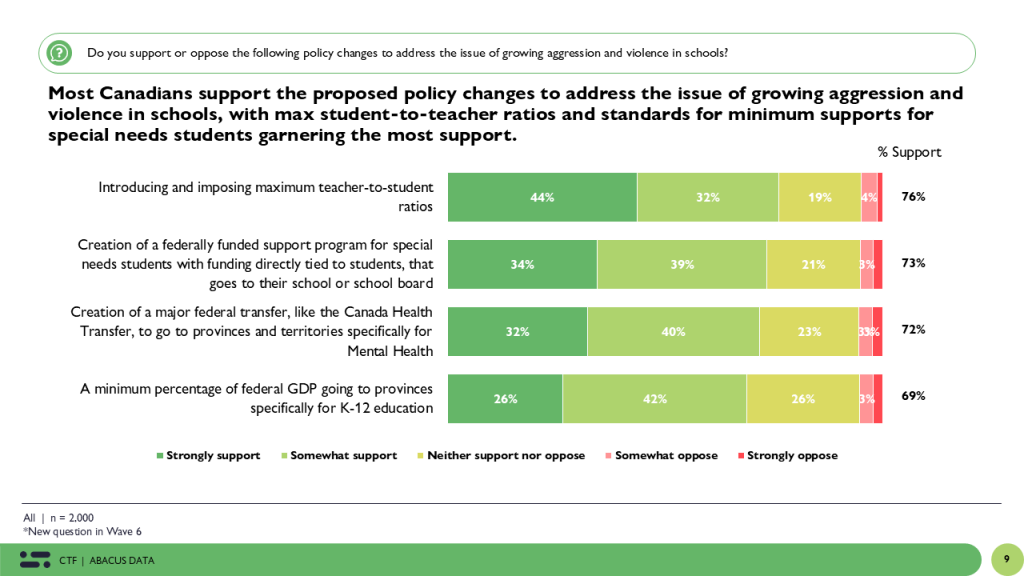
What stands out is not only that these measures receive majority support, but that support spans both direct classroom interventions and broader structural investments. Canadians appear to believe that addressing school violence will require more than one solution.
The Upshot
Canadians are increasingly concerned about violence and aggression in public schools. They believe the problem is real, growing, and serious enough to warrant action.
They also see the issue as connected to broader strains in the education system: declining respect for teachers, overcrowded classrooms, and insufficient supports for students and educators alike. In that context, it is not surprising that there is broad support for policy responses that would strengthen staffing, improve mental health supports, and increase resources flowing into schools.
At the same time, Canadians place a great deal of trust in teachers and the role they play in building a strong education system. With 83% saying teachers are important to a strong public education system, the public mood is not just about concern, but about giving educators the support and tools they need to succeed.
For governments and education leaders, the message is clear: Canadians want safer schools, and they are open to concrete action to make that happen.
Methodology
The survey was conducted online with 2,000 Canadian adults from March 17 to 23, 2026. The data were weighted by age, gender, education, and region. The margin of error for a comparable probability-based random sample of the same size is +/- 1.95%, 19 times out of 20. Totals may not add up to 100 due to rounding.
About the Public Education Journal
The Public Education Journal connects you to the stories, insights, and ideas shaping classrooms and communities across Canada. An initiative of the Canadian Teachers’ Federation, the voice of public education.
Join our community on Substack. Subscribe for free to receive new articles directly in your inbox.