
Why is Teaching Time Being Lost to Classroom Management?
Canadian students have not become “more difficult to teach” — a lack of specialized support means teachers’ time is increasingly fragmented.
Canadian students have not become “more difficult to teach” — a lack of dedicated support means teachers are fragmenting their time more and more to meet their students’ needs, while being systematically ignored by Ministers of Education.
Walk into a K–6 classroom, and you’ll see learning happening but, often in short bursts, interrupted by the need to redirect, reassure, de-escalate, repeat instructions, or manage conflict. The fall 2025 edition of Parachute quantifies a teacher’s day in a significant way: 25% of their teaching time is consumed by classroom management.
That’s one full minute out of every four.
Along with the time required for administrative duties, preparation, assessments, and direct instruction, educators are having to redirect 25% of their time to respond to increasing classroom needs. Teachers have always had to manage complex behaviours in their classrooms; what we are seeing now is how the lack of support is wreaking a significant toll on classrooms across the country. This is a systemic issue that teachers cannot address solely at the classroom level. When a quarter of the school day goes to managing behaviour, the time needed for all the tasks associated with teaching gets compressed — instructional time, most of all. Students who need structure get inconsistency. Students who need small-group help get delayed support, and the list goes on.
The weight of classroom management has become increasingly unbearable: an unplanned, under-resourced area of training, professional learning, and one that educators often navigate alone, alongside all other subject matters.
The solution is not “discipline reform” or better classroom management strategies. The problem is systemic: insufficient staffing and inadequate access to specialists create the unspoken expectation that every need — from mental health to academic intervention — will be met by one educator in one room.
Research, professional consensus, and educator testimony across the country all point toward the same destination: adequately staffed schools with the specialists and services to match. The data is clear, the harm is measurable, and the profession has been signalling this concern for years. The only remaining question is whether governments will act before students lose more of their school day to an issue that has always been avoidable if adequately funded and supported.
— Rolf-Carlos Klausener and Dr. Nichole Grant
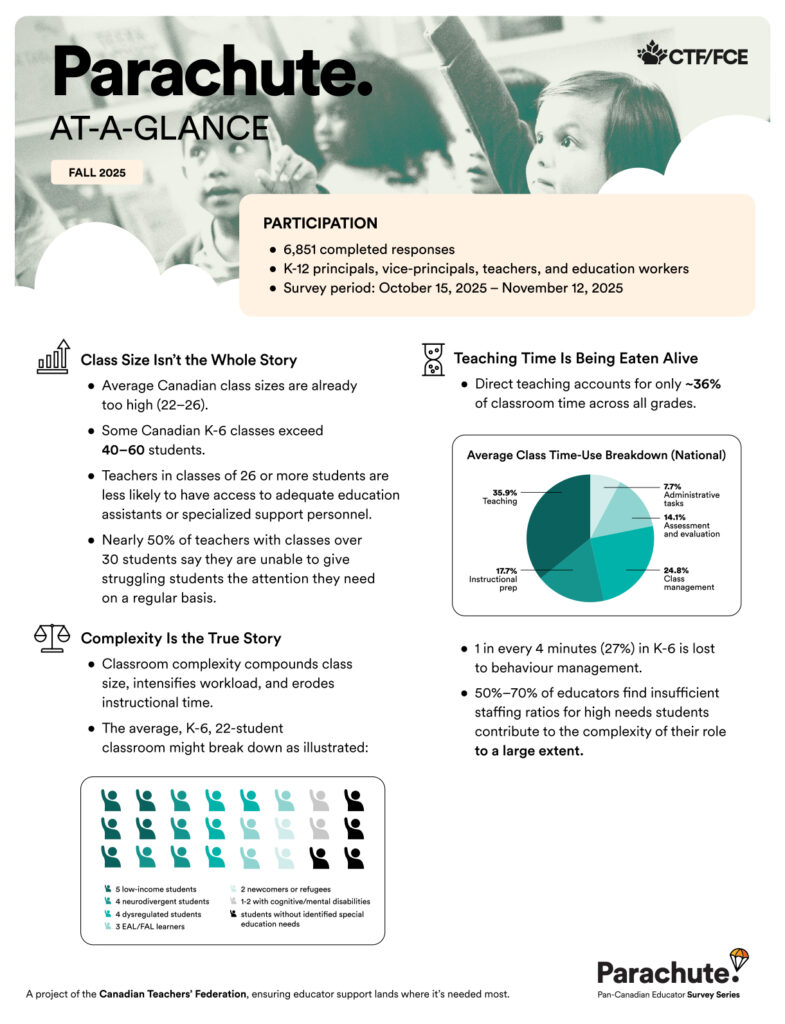
For more national data on class size and complexity, download the Fall 2025 Parachute At-A-Glance report (PDF, 5.6 MB), or visit the Parachute Educator Survey Series webpage.
About the Public Education Journal
The Public Education Journal connects you to the stories, insights, and ideas shaping classrooms and communities across Canada. An initiative of the Canadian Teachers’ Federation, the voice of public education.
Join our community on Substack. Subscribe for free to receive new articles directly in your inbox.